


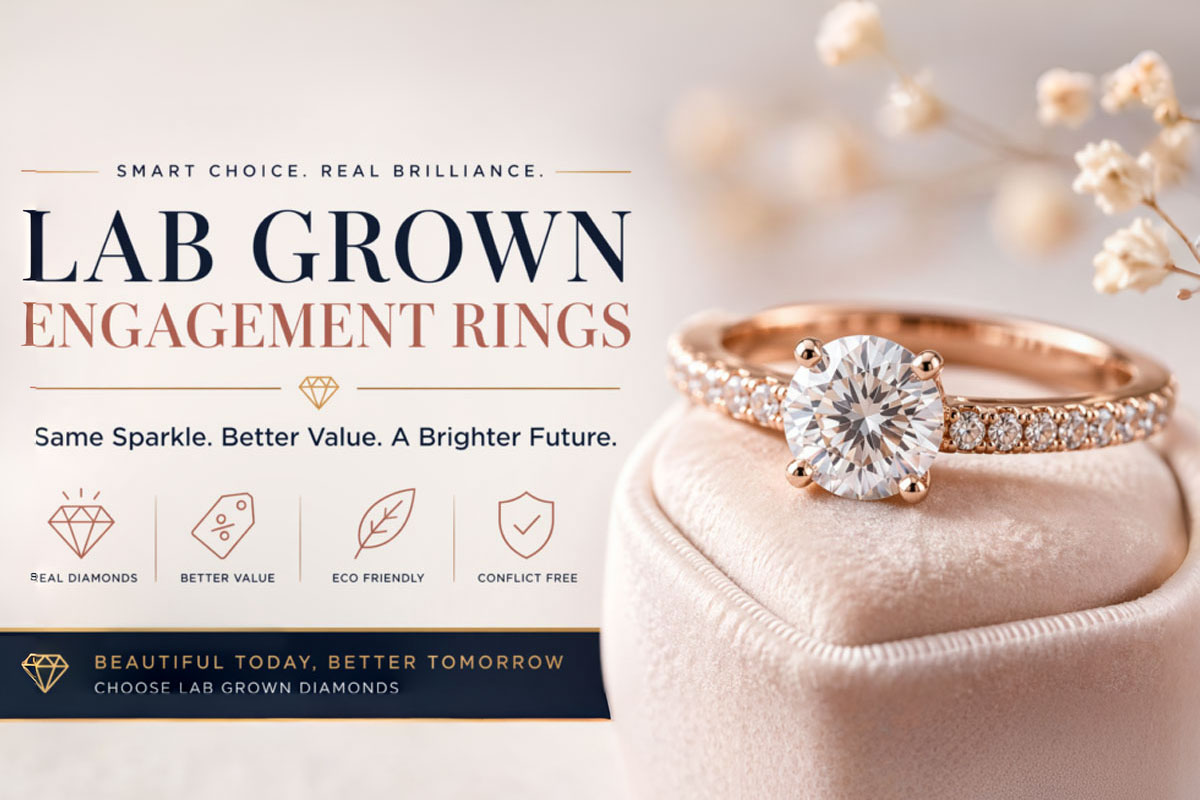
Lab-Grown Engagement Rings: A Smart & Modern Choice
Lab-Grown Engagement Rings: Definition
The term “lab-grown engagement rings” refers to jewelry that is made of lab-produced diamonds. Nevertheless, they cannot be confused with artificial diamonds since they have the same physical, chemical, and optical characteristics as genuine diamonds.
Thus, lab diamonds are indeed real diamonds except for their origin. While natural diamonds take thousands of years to emerge, laboratory diamonds are made within a couple of weeks.
As a consequence, one can get an amazing product that combines modern technology and nature.
Reasons Behind the Popularity of Lab-Grown Engagement Rings
Nowadays, couples prefer lab-grown diamonds. In this regard, let us examine the primary causes behind this trend.
- Firstly, the lower price tag is the first reason. Compared to natural diamonds, lab diamonds are 40-70% cheaper. This means that the buyer may obtain a diamond ring with a higher carat number or higher quality within the same budget.
- Secondly, lab production has an environmentally friendly aspect. As opposed to diamond mining, it utilizes fewer natural resources. Consequently, many consumers prefer this environmentally responsible choice.
- Thirdly, lab diamonds resemble natural diamonds. Only experts with specific equipment can differentiate between the two varieties. Hence, the buyer will benefit from the same beauty.
- Fourthly, lab production does not involve mining. For this reason, the consumer may eliminate the risks related to conflict diamonds.
Trends in Lab-Created Engagement Ring Styles
Style is as important as the diamond itself. Here are some styles worth considering.
Solitaire Diamond Rings
One diamond rests at the center of the ring. This ensures that the ring design is elegant and timeless.
Halo Set Diamond Rings
The center diamond has smaller diamonds around it. Hence, the ring has an enhanced size and brilliance.
Oval and Cushion-Shaped Diamonds
These stones have a modern feel. Moreover, they elongate the fingers.
Hidden Halo Style
The halo setting remains concealed underneath the center stone. Thus, the ring shines but does not become ostentatious.
Lab-Grown vs Natural Diamond Rings
Now, let’s compare lab-grown and natural diamonds side by side.
| Feature | Lab-grown diamonds | Natural Diamonds |
|---|---|---|
| Price | Lower | Higher |
| Origin | Lab-created | Mined |
| Look | Identical | Identical |
| Eco Impact | Lower | Higher |
| Resale Value | Lower | Higher |
How to Get the Best Lab-Grown Engagement Ring
Before choosing, pay attention to the following details.
Lab-grown diamonds are not
- Carat -> Base on your preference (from 1-2 Ct is perfect)
- Clarity -> VS or VVS will be clear
- Color -> EF or GH is good
- Cut: An excellent cut will bring the highest brilliance
- Certification -> Don’t forget to have the certification from IGI or GIA
Moreover, it’s always good to compare several offers. This will allow finding the best prices.
Some Facts to Remember
Lab-grown diamonds can be used perfectly as daily rings. On the other hand, it won’t be a good choice for an investment. Lab-grown diamonds usually have a lower resale value compared to natural diamonds.
At the same time, buyers often don’t care about resale value at all.
Helpful Resources (Internal Links)
- Clarity Chart for Diamonds
- Difference Between Moissanite and Diamonds
- Are lab-grown diamonds real?
- Resale Values of Diamonds
Final Thoughts
Lab-created diamonds offer both aesthetics and affordability along with innovation. It is possible to enjoy the sparkle of a natural diamond at a lower cost.
Thus, for those who seek more sparkly rings without spending too much, this choice is absolutely suitable.
At the end of the day, opt for a ring that suits your personality and budget.
Leave a Comment
Your email address will not be published. Required fields are marked *